


"Pray to God on this beautiful occasion of Diwali to give us light, to give us understanding, so that we may know what pleaseth thee, and may all prosper by the Grace."
A state, whose name is synonymous with exuberance, prosperity and an intense passion for life, Punjab or 'Panj Aab' literally meaning five rivers, is, as it were, the very heart of the country. The lightening of lamps on festival of Diwali is a way of paying obeisance to god for attainment of peace, love, wealth, health and knowledge. And on Diwali festival night people worship God and Goddesses and place Diyas (earthen lamps) in the home, in verandahs, courtyards, and gardens, as well on outer walls and on rooftops. It is time for Pooja and tradition and also time for fun and revelry.
In Punjab, Diwali Festival is the time for everyone to rejoice, looking forward to a bright future. Enthusiastically enjoyed by people of every religion, it's magical and radiant touch creates an atmosphere of joy and festivity. Diwali, festival of lights, symbolizes the victory of righteousness and lifting of spiritual darkness. The preparations of Diwali begin well in advance. People start decorating their homes, preparing sweets, thousand of lamps are lit to create a world of fantasy. Each house entrance is made colorful with lovely traditional motifs of "Rangoli" designs to welcome Laxmi, the goddess of wealth and prosperity.
In villages cattle are adorned and worshiped by farmers as they form the main source of their income. In the south, cows are offered special veneration as they supposed to be the incarnation of goddess Laxmi and therefore, they are adorned and worshiped on this day. In Punjab, winter crops are sown and the day following Diwali is celebrated as Tikka. On Tikka day, with saffron paste and rice, sisters place an auspicious mark on their brother's forehead, gesturing to ward off all harms from her brother.
Diwali is also the anniversary of Guru Hargobind ji being released from the prison at Gwalior Fort. In was on this day in 1619 A D. Diwali of Amritsar was out-of-the-world. Today, the entire Golden Temple is illuminated with traditional lamps of different colors during Diwali. The reflection of the temple in the shimmering water of the holy pool binds the eye, to the many-a-splendored pageant. Fire works display by the traditional professionals recreates the glory of the times gone past.

History traces these Diwali celebrations way back to the 17th century when the sixth Guru, Guru Hargobind secured the release of not only himself; but 56 other kings as well.
They all had been imprisoned at the Gwalior Fort during the reign of the Mughal emperor Jahangir. And, on this day the Guru and the Kings returned to Amritsar to a glorious welcome.
A number of religious gatherings are organized to mark this historical day in Sikh history by Sri Darbar Sahib (Golden temple) apart from arranging for community meals as well.
”Diwali is celebrated at a large scale here .There's nothing like food cooked at home but nothing compares celebrating Diwali at Amritsar,” says, a devotee, Sunny Singh.
While crackers spread the light, bandhi chor diwas spreads the message of Guru Hargobind Singh to help those struck by poverty and injustice.
A state, whose name is synonymous with exuberance, prosperity and an intense passion for life, Punjab or 'Panj Aab' literally meaning five rivers, is, as it were, the very heart of the country. The lightening of lamps on festival of Diwali is a way of paying obeisance to god for attainment of peace, love, wealth, health and knowledge. And on Diwali festival night people worship God and Goddesses and place Diyas (earthen lamps) in the home, in verandahs, courtyards, and gardens, as well on outer walls and on rooftops. It is time for Pooja and tradition and also time for fun and revelry.
In Punjab, Diwali Festival is the time for everyone to rejoice, looking forward to a bright future. Enthusiastically enjoyed by people of every religion, it's magical and radiant touch creates an atmosphere of joy and festivity. Diwali, festival of lights, symbolizes the victory of righteousness and lifting of spiritual darkness. The preparations of Diwali begin well in advance. People start decorating their homes, preparing sweets, thousand of lamps are lit to create a world of fantasy. Each house entrance is made colorful with lovely traditional motifs of "Rangoli" designs to welcome Laxmi, the goddess of wealth and prosperity.
In villages cattle are adorned and worshiped by farmers as they form the main source of their income. In the south, cows are offered special veneration as they supposed to be the incarnation of goddess Laxmi and therefore, they are adorned and worshiped on this day. In Punjab, winter crops are sown and the day following Diwali is celebrated as Tikka. On Tikka day, with saffron paste and rice, sisters place an auspicious mark on their brother's forehead, gesturing to ward off all harms from her brother.
Diwali is also the anniversary of Guru Hargobind ji being released from the prison at Gwalior Fort. In was on this day in 1619 A D. Diwali of Amritsar was out-of-the-world. Today, the entire Golden Temple is illuminated with traditional lamps of different colors during Diwali. The reflection of the temple in the shimmering water of the holy pool binds the eye, to the many-a-splendored pageant. Fire works display by the traditional professionals recreates the glory of the times gone past.
Amritsar: It is always said, Dal roti ghar ki, Diwali Amritsar ki, (There's nothing like food cooked at home but nothing compares celebrating Diwali at Amritsar)
Diwali celebrations in most households begin with Lakshmi pooja, but not many know that the Sikh community celebrates the day as Bandhi Chor Diwas. History traces these Diwali celebrations way back to the 17th century when the sixth Guru, Guru Hargobind secured the release of not only himself; but 56 other kings as well.
They all had been imprisoned at the Gwalior Fort during the reign of the Mughal emperor Jahangir. And, on this day the Guru and the Kings returned to Amritsar to a glorious welcome.
A number of religious gatherings are organized to mark this historical day in Sikh history by Sri Darbar Sahib (Golden temple) apart from arranging for community meals as well.
”Diwali is celebrated at a large scale here .There's nothing like food cooked at home but nothing compares celebrating Diwali at Amritsar,” says, a devotee, Sunny Singh.
While crackers spread the light, bandhi chor diwas spreads the message of Guru Hargobind Singh to help those struck by poverty and injustice.


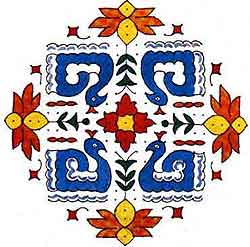 rangoli may also have come from "rang" (color) + "aavalli" (row), which means row of colors, or from rang+avalli, which means creepers of colors. Basically, Rangoli is the art of drawing images and motifs on the floor and walls of one's home using different color powders. Designed with a beautiful combination of various colors, the Rangoli images create an enchanting piece of art. Basically a floor painting, a rangoli image stands for a sign of welcome. The main purpose of making rangolis in diwali is to welcome Goddess Laxmi, the Goddess of wealth, to individual homes apart from warding off the evil eye. The art of rangoli is known by different names in different regions such as "Rangoli" in Maharashtra, Alpana (in Bengal), and Kolam (in South India). Although Rangoli has its origins in Maharashtra, today it is practiced everywhere. One of the most popular arts among Indian women, rangoli is an age old custom of India, and practiced all over the country.
 are also made. Rangolis can be of any size, from the size of a doormat, to the covering an entire room. Though making of a Rangoli is highly dependent on the preferences and skills of the maker, lines are always drawn on one finger movement (rangolis are always drawn with fingers) and frequently, the mapping of the rangoli is done with the help of dots, which are joined to form a pattern, and then the pattern is filled with colors. One important point is that the entire pattern must be an unbroken line, with no gaps to be left anywhere, for evil spirits are believed to enter through such gaps, if they find one. In an expert hand, the images created are elaborate and look as if they are painted. In India, this art is temporary. Each rangoli design generally stays for only a day or two as it is often redone as a part of the daily routine. Certain designs are created on special occasions such as weddings and religious festivals like Diwali.
 Rangoli designs are generally based on themes that have been in use through ages. The common rangoli themes are the celestial symbols such as the rising sun, moon, stars, zodiac signs, holy symbols like Om, mangal kalash, swastika, chakra, a lighted Deepak, trident, "shree", lotus etc. Goddess Lakshmi in the lotus symbolizes the figure of renewed life. Other popular themes are natural images like flowers, creepers, trees, fish, birds, elephants, dancing figures, human figures and geometrical figures such as circles, semi-circles, triangles, squares and rectangles. Drawing Diwali rangoli at the entrance door of individual homes is the common sight during Diwali decoration. For this, the footsteps of Goddess Lakshmi entering into the home are designed at the main entrance of the home or near the place of worship, which indicates the entrance of prosperity in the home. This is the special Diwali rangoli for the entrance. It is considered auspicious as it signifies showering of good luck and prosperity on the house and in the family.
 The new Timeline Facebook profile introduces Facebook Covers which we are super excited about. We are working hard to design lots of unique custom covers for your profiles. Preview this new timeline profile below.